The missing spaCy benchmark
spaCy self-proclaims as “Industrial-Strength Natural Language Processing”.
I can wholeheartedly agree. Over many years spaCy has served me extremely well as a base component in a diverse set of projects. The top reasons to use spaCy have always been:
- reliability
- speed
- ease of use
- acceptable accuracy out-of-box
Recently, document retrieval systems have been getting a lot of attention. In the light of this, I was curious to see how spaCy would hold up to this task. Usually spaCy is the most well-documented project in the industry. As with anything, there are edge cases.
On their website spaCy recommends two pre-trained pipelines:
- for efficiency use
en_core_web_sm - for accuracy use
en_core_web_trf
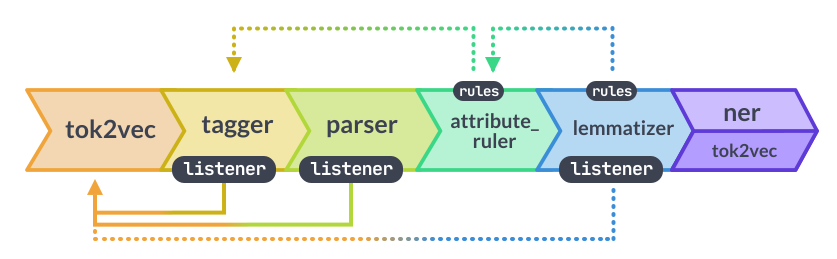
The idea is that the underlying embedding can be used as the input towards other components, such as the tagger, parser, attribute_ruler and lemmatizer (by default).
spaCy explains this neatly in their infographic.
In the case of spaCy 3.6.0, two different base architectures are available:
tok2vectransformer
This blog post deep-dives into the performance of the underlying embeddings.
spaCy’s homebrewed tok2vec
The model page of en_core_web_sm does outline that it uses tok2vec. What exactly is tok2vec though? This particular model architecture was quite new for me. Following down on the Tok2Vec component, it states:
The model to use. Defaults to HashEmbedCNN.
It turns out, this can default to HashEmbedCNN. But it doesn’t need to. Peeking into site-packages’s config.ini reveals the actually used implementation:
spacy.Tok2Vec.v2architecturespacy.MultiHashEmbed.v2embedding layer with width of 96 dimensionsspacy.MaxoutWindowEncoder.v2encoding layer with width of 96 dimensions
With this knowledge it is possible to run a citation search. From the paper [1] we quote:
To reduce the memory footprint, the default embedding layer in spaCy is a hash embeddings layer. It is a stochastic approximation of traditional embeddings that provides unique vectors for a large number of words without explicitly storing a separate vector for each of them. To be able to compute meaningful representations for both known and unknown words, hash embeddings represent each word as a summary of the normalized word form, subword information and word shape.
They go on to detail how the MultiHashEmbed layer can help reduce computational complexity, thus improving spaCy’s speed.
In the paper they describe evaluations on 5 different datasets focusing on named entity recognition. Most notably OntoNotes see [2] and CoNLL 2002 see [3].
spaCy v3 & the advent of transformers
In 2021 explosion released the next iteration of spaCy. Its most prominent feature is accessible and fast transformer-based pipelines.
Like the tok2vec based counterpart, specifics of the model are hard to come by from the documentation. The config.ini let’s us know that en_core_web_trf:
- contains a
spacy-transformers.TransformerModel.v3of typeroberta-base - was trained on
spacy.Corpus.v1 - uses a window of
128and stride of96dimensions with a maxout layer to produce768dimensional tensors
Unlike en_core_web_sm however there is no technical report on the performance of the model. The benchmarks page outlines that the model performed state-of-the art in 2020.
For comparison with the tok2vec model they include OntoNotes and CoNLL 2002. en_core_web_trf outperforms the classification task for OntoNotes by 26.5% (from 0.66 to 0.89), and 19.4% (from 0.74 to 0.91) for CoNLL 2002 respectively.
How do spaCy models fare up on different tasks?
If we want to know which tasks the spaCy base models can perform well out of the box, we should be evaluating the models more rigidly. Fortunately, the massive text embedding benchmark [4] can help us with this. Quoting the authors of MTEB:
MTEB is a massive benchmark for measuring the performance of text embedding models on diverse embedding tasks.
The core evaluation consists of 67 datasets across seven domains:
- Classification
- Clustering
- Pair classification
- Reranking
- Retrieval
- STS
- Summarization
Running spaCy’s models via MTEB
Running MTEB is fairly straightforward. They have a standard template to copy from. The most important part is implementing a custom model:
def encode(self, sentences, batch_size=32, **kwargs):
    """
    Returns a list of embeddings for the given sentences.
    Args:
        sentences (`List[str]`): List of sentences to encode
        batch_size (`int`): Batch size for the encoding

    Returns:
        `List[np.ndarray]` or `List[tensor]`: List of embeddings for the given sentences
    """

    if self.trf_model:
        return [
            np.mean([tensor.get() for tensor in doc._.trf_data.tensors[1]], axis=0) if len(doc._.trf_data.tensors) > 1 else np.zeros(768, dtype=np.float32)
            for doc in self.nlp.pipe(sentences, batch_size=batch_size, disable=DISABLED_COMPONENTS, n_process=1)
        ]
    else:
        return [
            doc.vector if len(doc.vector) else np.zeros(96, dtype=np.float32)
            for doc in self.nlp.pipe(sentences, batch_size=batch_size, disable=DISABLED_COMPONENTS, n_process=-1)
        ]
For convenience I have included a simple evaluation script. Unfortunately the code for the leaderboard is more difficult to access, which is why I additionally created a script to provide averages.
Evaluation results
For the evaluation I added 3 more sensible models for comparison, namely:
- all-MiniLM-L12-v2 which is the widely accepted industry standard for text embeddings
- bge-base-en the state of the art model (monolingual) with equivalent embeddings to
en_core_web_trf - multilingual-e5-small a multilingual allrounder model, producing the same embedding space as
all-MiniLM-L12-v2
The following table gives an overview of the model configurations:
import pandas as pd
from IPython.display import display, HTML

model_df = pd.DataFrame([
    ("en_core_web_sm", "tok2vec", 96, 0.12),
    ("en_core_web_trf", "transformer", 768, 0.44),
    ("bge-base-en", "transformer", 768, 0.44),
    ("all-MiniLM-L12-v2", "transformer", 384, 0.12),
    ("multilingual-e5-small", "transformer", 384, 0.47)
], columns=["model", "architecture", "dimensions", "size in GB"])
display(HTML(model_df.to_html(index=False)))
| model | architecture | dimensions | size in GB |
|---|---|---|---|
| en_core_web_sm | tok2vec | 96 | 0.12 |
| en_core_web_trf | transformer | 768 | 0.44 |
| bge-base-en | transformer | 768 | 0.44 |
| all-MiniLM-L12-v2 | transformer | 384 | 0.12 |
| multilingual-e5-small | transformer | 384 | 0.47 |
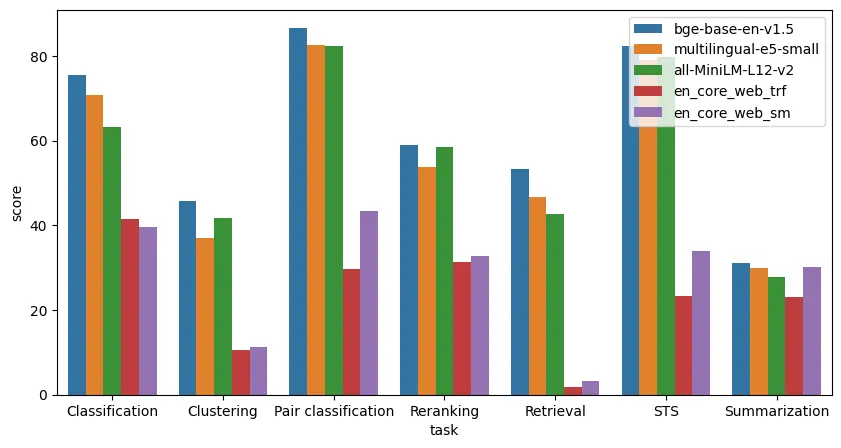
Once the analysis is run, we can create a barchart for comparison:
import seaborn as sns
import matplotlib.pyplot as plt

df = pd.read_csv("spacy_mteb.csv", header=None, names=["model", "task", "score"])
fig, ax = plt.subplots(figsize=(10, 5))
sns.barplot(df, x="task", y="score", hue="model", ax=ax)
plt.legend(loc='upper right')
plt.show()
Observations
en_core_web_trfis better at classification tasks thenen_core_web_sm(albeit not by a large margin)en_core_web_smbeatsen_core_web_trfat all other tasks- The difference between
bge-base-1.5,multilingual-e5-smallandall-MiniLM-L12-v2is miniscule - Both
en_core_web_trfanden_core_web_smconsistently lack ten or more points behind the models used for comparison
The results are not surprising. If the spaCy authors have followed through on their paper and developed their models for NER classification tasks, it makes sense that they would not (inherently) do well on other tasks. What strikes me as odd is the fact that en_core_web_trf only marginally (+ 1.84) outperforms en_core_web_sm when ran on a wide class of classification problems.
Conclusions
- spaCy models are designed with NER in mind
- The built-in models of spaCy can’t be used for retrieval tasks
- If one wants to build components in spaCy that are not classification tasks, they should be using a different Transformer
One needs to be wary that fine-tuning other models however may be detrimental to their performance, careful evaluation is necessary before deploying a different then the built-in transformer.
Finally, I would like to emphasize that this is in no way meant to belittle the monumental effort and usefulness of spaCy. It remains a battle-tested software for its designed purpose.
Acknowledgments
This evaluation wouldn’t have been possible without compute that was graciously provided by YUKKA Lab AG. Further I would like to thank Mingzhu Wu for all her helpful comments that made this evaluation more complete!
References
[1] Lester James Miranda, Akos Kadar, Adriane Boyd, Sofie Van Landeghem, Anders Sogaard, Matthew Honnibal, “Multi hash embeddings in spaCy” — arXiv preprint arXiv:2212.09255, 2022.
[2] Ralph Weischedel, Martha Palmer, Mitchell Marcus, Eduard Hovy, Sameer Pradhan, Lance Ramshaw, Nianwen Xue, Ann Taylor, Jeff Kaufman, Michelle Franchini et al., “Ontonotes release 5.0 ldc2013t19” — Linguistic Data Consortium, Philadelphia, PA, vol. 23, p. 170, 2013.
[3] Erik F. Sang and Fien De Meulder, “Introduction to the CoNLL-2003 shared task: Language-independent named entity recognition” — arXiv preprint cs/0306050, 2003.
[4] Niklas Muennighoff, Nouamane Tazi, Loïc Magne, Nils Reimers, “MTEB: Massive text embedding benchmark” — arXiv preprint arXiv:2210.07316, 2022.